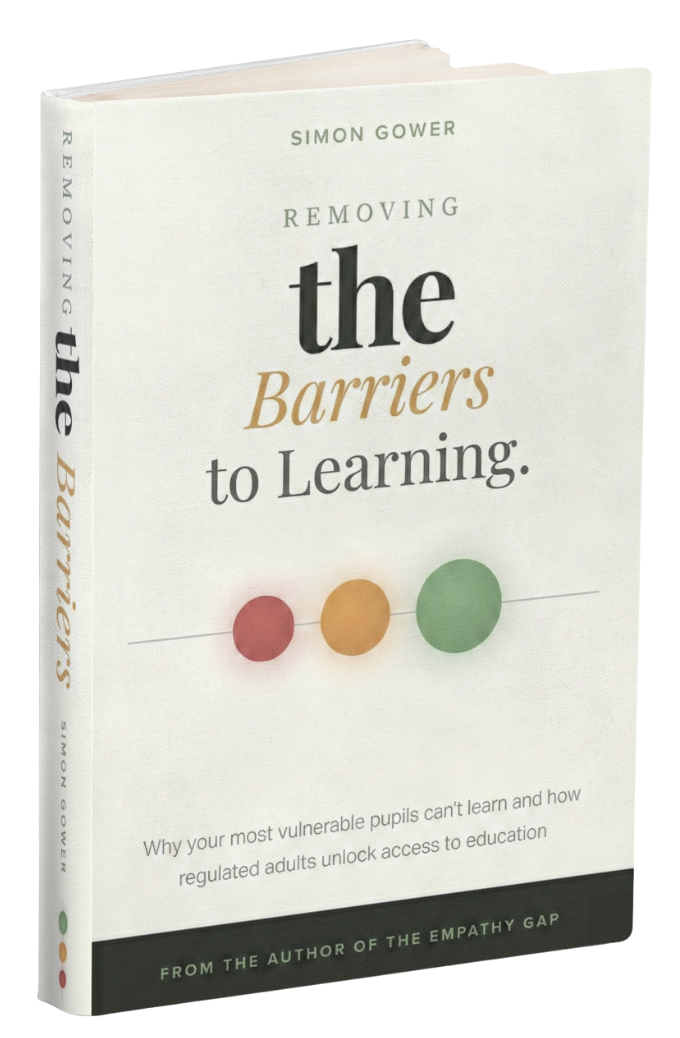
You're watching good teachers burn out, challenging children get excluded, and every new initiative fade within a term. There is a reason nothing has worked. And there is a way to fix it.
Join the waiting listFrom the author of The Empathy Gap
It's 8:47am on a Tuesday. You've been in the building since 7:15. Thirty children walk through your door in thirteen minutes.
You know that at least five of them had difficult mornings. One witnessed an argument. One didn't eat breakfast. One hasn't spoken to another human since she left school yesterday.
You have been trained in phonics, in differentiation, in behaviour management. You have a degree. You have years of experience.
What you have never been trained in is the one thing that determines whether any of that works.
How to keep your own nervous system regulated enough to help those five children regulate theirs, while simultaneously teaching the other twenty-five.
On the days when you can't do that, when your own stress is running high and your patience is a thread, you don't just fail to reach those children. You neurobiologically make it harder for them to learn.
Not because you're a bad teacher. Because you're a human being with a nervous system. And the science on this is now unequivocal.
The numbers your school already knows but doesn't know how to fix
These are not separate problems. They are the same problem, seen from two sides of the classroom.
What if the barrier to learning isn't behaviour?
Every school has a behaviour policy built on the same assumption: that children who disrupt learning are making a choice, and that consequences will change that choice.
The neuroscience of the last twenty years has demolished this assumption.
When a child's nervous system detects threat, the prefrontal cortex, responsible for reasoning, working memory, impulse control, and everything we call "learning," goes offline. The amygdala takes over. Stress hormones flood the system.
The child has not chosen to stop learning. Their brain has switched from learning mode to survival mode. No sanction will switch it back.
Only one thing will. A regulated adult whose nervous system signals safety.
This is not a soft, idealistic claim. It is a neurobiological fact supported by decades of research from Stephen Porges, Bruce Perry, Bessel van der Kolk, Amy Arnsten, and Dan Siegel.
The metaphor that will change how you see every child
Imagine a child's brain as a library. On the shelves sit everything they need for learning. When the child feels safe, the doors open wide. Learning happens.
Now imagine that child arrives at school having witnessed violence the night before. Their nervous system is in threat mode. The library doors lock. The books are still there. The child has not become less intelligent. But access has been blocked.
When you deliver a lesson to that child, you are shouting instructions through a locked door.
No behaviour policy can unlock it. No sanction. No reward chart. Only a regulated adult whose calm, present nervous system sends a signal: it is safe. The library can open.
But the adult can only send that signal when their own nervous system is regulated. When the adult is stressed, exhausted, and overwhelmed, their nervous system sends a different signal. One that keeps the library locked. One that can lock more doors.
This isn't theory. The research is unequivocal.
Teacher stress physically changes children's biology
Researchers at the University of British Columbia measured cortisol in 406 elementary school children. 10% of the variability in children's morning cortisol was explained at the classroom level. Higher teacher burnout predicted higher children's stress hormones.
Oberle and Schonert-Reichl, 2016, Social Science and Medicine
Teacher burnout directly impairs academic achievement
A study of 1,102 German elementary school teachers found a significant negative relationship between teacher emotional exhaustion and student achievement in mathematics.
Klusmann et al., 2016
Stress shuts down the brain regions children need for learning
Working memory, essential for reading comprehension, problem-solving, and mathematics, is impaired by stress hormones acting on the prefrontal cortex and hippocampus.
Almarzouki, 2024, Stress; Arnsten, 2009, Nature Reviews Neuroscience
Classroom stressors trigger cascades that impair memory
Challenging classroom situations activate two major stress systems that modulate how memories are formed, consolidated, and retrieved.
Schwabe et al., 2016, npj Science of Learning
Your school has probably tried most of these
Behaviour management training teaches staff what to do when a child is dysregulated. That knowledge is stored in the prefrontal cortex, the same region that goes offline when the teacher is stressed. The training is excellent. The delivery system is compromised.
Trauma-informed awareness helps staff understand why a child is struggling. But understanding doesn't give the adult the neurobiological capacity to regulate the child. Knowledge sits on an inaccessible shelf when the adult's own library has locked.
Wellbeing programmes offer strategies for managing stress outside the classroom. They don't equip adults to regulate in real time, mid-lesson, with 30 children watching.
Exclusion and sanctions remove the dysregulated child. The children most likely to be excluded are those whose nervous systems are most chronically dysregulated. Exclusion reinforces the very dysregulation it attempts to address.
What's missing is the adult's regulatory capacity as the primary intervention.
Not as a wellbeing initiative. As the single most important determinant of whether children can access learning. This book addresses that gap.
Ten chapters. Two parts. One transformation.
Why "won't learn" is almost always "can't learn." What happens in a child's brain under threat. How your stress crosses the classroom. Why the adults closest to the crisis are furthest from the resources. And why this is the system's failure, not yours.
Regulation tools that work in 30 seconds. The "green light classroom." The RIPPLE Framework for schools. Behaviour policy redesign. Staff support systems. Leadership as regulation. And the Barriers to Learning Audit.
The daily reality made visible. Including a dedicated section on teaching assistants as the forgotten frontline.
The neuroscience of why children can't learn under stress. The Traffic Light system and Locked Library metaphor. After this chapter, you will never see a "disruptive" child the same way.
ACEs in your classroom. The statistical reality. Why the exclusion system is neurobiologically designed to fail.
How your nervous system broadcasts to 30 children. The cortisol contagion research. The Achilles Heel of teacher training.
Workload, assessment pressure, pay erosion, leadership culture. The paradigm shift from individual burnout to systemic responsibility.
Why stoicism in teaching is neurobiologically harmful. What authentic professional presence actually looks like.
Micro-regulation for classroom life. Tools that work during lessons, in transitions, in the 30-second windows between crises.
The practical heart. Environmental design, relational practice, pedagogical approaches that account for nervous system states.
The RIPPLE Framework for education. Behaviour policy revolution. Leadership as the thermostat for the building.
Real schools, real results. The financial case. The Barriers to Learning Audit. Your transformation pathway.
Written for every adult in the building
Headteachers and senior leaders
Who know the behaviour policy isn't working but don't know what to replace it with. Who have watched good teachers leave because the system broke them. This book gives you the framework.
SENCOs and pastoral leads
Who carry the weight of every struggling child and know that current interventions treat symptoms, not causes. This book shows you what a neurobiologically-informed approach looks like.
Classroom teachers
Who entered this profession to make a difference and now spend most of their energy managing behaviour. This book shows you it isn't your fault, and gives you tools that work within your real constraints.
Teaching assistants
Who know these children better than anyone and provide the regulation that makes learning possible, for a fraction of a teacher's recognition. This book sees you. This book is for you.
MAT leaders and LA teams
Responsible for outcomes across multiple schools, facing unsustainable exclusion data and rising SEND referrals. This book provides the evidence base for system-level transformation.
Every adult in a school
Lunchtime supervisors, office staff, caretakers. Every adult is part of the regulatory environment. Every nervous system matters. This book explains why.
Every term that passes...
More teachers leave. England now has the worst attrition rate among developed nations. Every teacher who goes takes their relationships and their investment with them.
More children are excluded. Over 10,900 permanently excluded in 2023/24. The majority for "persistent disruptive behaviour" that is, in neurobiological terms, a chronic nervous system state that exclusion can only reinforce.
More teaching assistants absorb the dysregulation of the most vulnerable children without the training, the pay, or the support to sustain it.
The neuroscience is clear. The evidence is published. The framework exists.
The children in your school are waiting for the adults around them to understand what is actually happening in that classroom.
Simon Gower
CEO and founder of ProActive Approaches. Author of The Empathy Gap: Burnout to Breakthrough (2025), the book transforming how residential childcare understands the relationship between staff wellbeing and outcomes for traumatised young people.
Simon's career spans nearly three decades as a practitioner in both residential childcare and special schools, giving him first-hand understanding of what it means to work with dysregulated children in settings where the stakes are highest and the resources are thinnest. For the last 15 years, he has delivered training and consultancy for schools across the UK, translating cutting-edge neuroscience from researchers including Stephen Porges, Bruce Perry, and Bessel van der Kolk into practical frameworks that time-pressed staff can implement immediately.
The results speak for themselves. In residential settings, Simon's approach has achieved documented reductions of 80 to 90% in physical interventions and 60 to 70% in staff turnover. In schools, his work has delivered 80% reductions in behavioural incidents, demonstrating that the same neurobiological principles that transform residential care apply directly to classrooms, corridors, and playgrounds.
His RIPPLE Framework and BILD Act certified training programmes address the neurobiological foundations that traditional behaviour management approaches miss entirely.
Removing the Barriers draws on this dual experience, applying the same evidence base to the 757,000 teachers and teaching assistants in England and the 8.7 million children whose access to learning depends on the regulatory capacity of the adults around them.
Every child who "won't learn" is a child whose brain can't. This book shows you how to unlock the door.
Join the waiting list to be first to know when the book launches. Schools ordering 10+ copies will receive a complimentary Barriers to Learning Audit.
✓ No spam. Just launch news and one valuable insight before anyone else.
Removing the Barriers — by Simon Gower
For the teachers and teaching assistants who walk into classrooms every morning carrying more than anyone sees. And for the children sitting in those classrooms, unable to access the learning that surrounds them, not because they won't, but because their nervous systems can't.
You both deserve better systems. This book shows you how to build them.